Sunday, January 20, 2013

Olympus PEN Lite / E-PL3 Review


The Olympus PEN Lite/E-PL3 is identical in terms of output to the recently reviewed Olympus E-P3. We have tested to verify image quality (and of course include these tests in the review). Where appropriate, you will find our comments and judgements identical to those expressed in our in-depth review of the Olympus E-P3. Much of the original content in this article then is devoted to assessing features and functionality unique to the E-PL3.

From the outset, Olympus has positioned its E-PL lineup as a simplified, lower-cost alternative to its higher-end E-Px cameras. The release of the third generation Olympus PEN E-PL3 (dubbed PEN Lite) continues this tradition while sporting much of the functionality and nearly all of the performance gains of its big brother, the Olympus E-P3. One difference this time around, however, is the simultaneous arrival of the E-PM1/PEN Mini, which now becomes the entry-level model in the PEN lineup. The PEN Lite sits between the PEN Mini and Olympus' flagship E-P3, offering a combination of external control points and compact-camera-like handling that may appeal to those who want high image quality in a small package, and are ready to move beyond an 'auto everything' experience.

The PEN Lite introduces handling and operational changes from its predecessor, the Olympus PEN E-PL2. Among the most obvious of these are the lack of a hand-grip along the front plate, the addition of a tilting 16:9 format LCD screen and a clip-on flash unit that occupies the hot shoe and rear accessory port (in contrast to the E-PL2's built-in flash). While it shares a sensor and image processing engine with the higher-priced E-P3, the PEN Lite has more distinct styling and better feature differentiation from the high end model than we've previously seen. As such, the E-PL3 is a very different looking camera than its predecessor, the E-PL2. In fact, the design aesthetic and reduced size of the E-PL3 point more closely to that of the Olympus XZ-1 compact camera; a none-too-subtle hint perhaps at Olympus' intended target audience.

Make no mistake, however, the E-PL3 does not skimp on features. External control points, a mode dial, hot shoe and accessory port all carry over from the E-PL2. And, as we've come to expect from a PEN series model, the E-PL3 offers a high degree of customization over camera operation along with a variety of art filters and effects that can be applied to JPEG image captures. We're also pleased to note that, like the E-P3, the PEN Lite has an AF illuminator to assist low-light focus acquisition.

Having regularly acted as a trailblazer (Olympus was an early exponent of DSLR live view, in-camera image stabilization and art filters), and subsequently watching other manufacturers adopt similar features, the E-PL3 sees Olympus taking the opportunity to borrow ideas for a change. There's something decidedly NEX-like about the E-PL3's protruding lens mount and tilting LCD screen, not to mention its separate clip-on flash.

Curiously, the PEN Lite's flip-out screen is in the 16:9 aspect ratio - well suited for shooting HD video but much less so when shooting stills in the camera's native 4:3 format. This format mismatch leaves black bars down both sides of the screen, areas which are then solely devoted to displaying camera settings.

Olympus PEN Lite key specifications:
  • Updated 12MP Live MOS sensor
  • 120 Hz 'Fast AF' focus system with 35-point area AF
  • Clip-on flash (included)
  • Built-in autofocus illuminator light
  • 460,000 dot tilting LCD screen (16:9 aspect ratio)
  • Dual-core TruePic VI processor
  • 1080i60 movies in AVCHD format
  • Shadow tone adjustment control
  • Revised and expanded Art Filter mode (with quick preview option)
 Compared to the Olympus PEN E-P3

 
 Differences between the PEN Lite E-PL3 and PEN E-P3
  • Faster continuous shooting: up to 5.5fps vs. 3fps
  • Tilt/flip LCD display vs. fixed OLED screen
  • Lower resolution screen (460,000 vs. 614,000 dots) in 16:9 vs. 3:2 aspect ratio
  • No thumb dial
  • No orientation sensor
  • Slower flash sync speed of 1/160th vs. 1/180th of a second
  • Four fewer Art Filters (Loses Pale Light & Color, Light Tone, Gentle Sepia and Cross-Process)
  • No built-in flash (clip-in unit included)
  • No level gauge


Sunday, November 4, 2012

Samsung Galaxy S Blaze 4G Review: Blazing Fast

 While it may look like another rehash of the old Galaxy S, under the hood the new Samsung Galaxy S Blaze 4G packs blistering speed, with a 1.5 GHz dual-core processor and lightning fast 4G. Does the rest of the device measure up? We take an in-depth look.

This model is available exclusively at T-Mobile USA for $150 with a two-year service contract and $50 mail-in rebate. Without the contract it's $450.

 Build & Design
Given its name, you would expect that the Galaxy S Blaze 4G is a rewarmed version of the two-year-old Galaxy S in a new package. Well, not exactly. While it has undeniable similarities, it's clear that the Blaze has been through quite a retrofit, delivering a much more modern experience.

The first impression you get from holding the Blaze is that it's remarkably light, even for a keyboard-less device. There's several reasons for that, including the screen (which we'll talk about in a minute) and the relative simplicity of the design.

This smartphone's design is very minimalist: no clutter, no extra parts, it's pretty much just literally the screen and the battery. Nicely enough, the microSD card is accessible from a side door without removing the main battery cover.

The Blaze probably isn't the most bulletproof device in existence, given how light it is, but there's nothing really to complain about with the build quality. It's simple, it's solid, and northing's going to pop off or go bad too quickly. It's simplicity in action.

Screen
Part of the reason for the Blaze's lightness is its Super AMOLED screen. Displays of this type use a single layer of glowing elements to form the picture, instead of regular LCDs which have one layer to create a picture and another to light it up. This makes Super AMOLED thinner and lighter than other screens, as well as providing better contrast, with black actually appearing as black rather than dark grey. The Blaze uses the same basic Super AMOLED screen seen in a lot of Samsung's older or mid-range models, not as clear and vivid as the ones in the Galaxy S II and Samsung Infuse, but still nice. Even contrasted against your average, more modern LCD, it's going to hold up very well.

Performance
Without a doubt, the Samsung Galaxy S Blaze 4G's highest end spec is its processor: a whopping 1.5 GHz dual-core chip gives it as much raw power as just about any smartphone out there, even the higher end stuff. That makes it an ideal choice for games and high-end video for those who don't want to break the bank. Using Quadrant Standard benchmarks, the Blaze earned a whopping 3565 average. When you consider that the Verizon flagship Motorola Droid RAZR MAXX only scores around 2700, that's impressive.

Once you branch out past the processor though, the Blaze is pretty standard mid-range fare. Running on the slightly older Android  OS 2.3 (Gingerbread), it isn't the sort of device I'd expect to see get an Android 4.0 upgrade, so don't count on it. But then, there's as yet very little real advantage using 4.0, as most apps are still designed for 2.3.

A lot of the online spec sheets about the model are wrong: it definitely does not have 16 GB of memory. Instead, it has 4 GB internal (of which 2 GB are available) and is pre-loaded with a 4 GB microSD card. That adds up to a reasonable amount for a middle of the road device, but not nearly so exciting as if the spec sheets had been right.

One unfortunate quality is that the Blaze comes stocked with a lot of T-Mobile branded "bloatware" apps. While it's not quite as bad as some of the Verizon models, the ten -- yes, ten -- T-Mobile branded apps like their own app store, their own version of 411, their own version of caller ID, etcetera, do tend to be tiresome. And they can't be uninstalled, although you can at least remove the widgets that come plastered all over the home screen.

Communication
While T-Mobile is currently the only major provider that isn't deploying an LTE network, that doesn't mean you should underestimate their own high speed internet options. The carrier's souped-up HSPA network is still amply capable of delivering broadband at speeds of 10 to 12 megabits downstream, which is competitive with even Verizon's 4G LTE service. Uploading is slower, but not so slow that it should bother you unless you're sending 50 MB videos on a regular basis.

A nice thing about T-Mobile's service that you can't get elsewhere is their WiFi Calling option. Basically, whenever you're hooked up to WiFi your T-Mobile Android phone will default to running your phone's voice, data, and messaging all over the WiFi connection. This effectively gives you the same thing as native T-Mobile service anywhere you can get WiFi, even if you're way, way out in the boondocks, or buried deep in an office building with no other reception. And unlike the signal boosters offered by other providers, you don't need any special hardware or setup, and it works anywhere.

One slightly surprising inclusion on the Blaze is Near Field Communication, or NFC. This is a means to transmit small bits of information such as URLs, contact information, or other bits of text. This can be device to device, like sharing a contact; picking up a URL from an NFC-enabled poster or advertising display; or transmitting data or an authorization from your phone to another device. NFC hasn't seen much adoption in the US, but Google has been pushing it for use with their "Google Wallet" service, essentially trying to make your smartphone into also being your credit card. Although why you'd want that, I have a hard time imagining.

Productivity

Unfortunately the Blaze doesn't stock over-much in the way of productivity software. Beyond the standard email, contacts, and organization apps, the only other particularly useful thing it sports is a copy of Polaris Office, allowing you to work with Microsoft Office documents while on the go.

Entertainment
There's much more of an emphasis on entertainment with the Blaze, with not just Google's own music, books, and video apps included, but also clients for T-Mobile's version of MobiTV, Netflix, and Zinio. All of which, unfortunately, require paid subscriptions to get the most out of them, but at least they mostly offer free trials too.

Camera
In the camera department, this Samsung smartphone unfortunately hasn't gotten an upgrade from its ancestors. While its 5 megapixel camera is a fairly standard resolution, the optics leave a lot to be desired, giving you fuzzy photos lacking in detail compared to other phones based on more recent designs. Even in good light, you will lose a lot of detail.

Battery Life
Despite being a fairly slim and light device, the Blaze packs a 1750 mAh battery. That's close to standard size if you're talking about devices running on LTE, but for T-Mobile's network it's well above the rest of the crowd, giving the device excellent battery life. It's pretty safe to say that you'll get through the day with this thing even if you're using it roughly with a lot of 4G and the brightness cranked up.

Conclusion
 All in all, the Samsung Galaxy S Blaze 4G makes for a fairly good Android phone. Is it worth your $150? I would give it a conditional yes. Of all the major carriers, T-Mobile probably has the scarcest options in terms of good Android devices. Compared to the rest of the carrier's offerings, the Blaze makes a decent mid-point between the newer Samsung Galaxy S II on the higher end, and the truly cheap options like the T-Mobile Sidekick 4G and the Samsung Exhibit II.

That said, the Blaze isn't going to match up with the amount of bang for your buck that you'd get on other carriers. The same price on AT&T or Verizon would net you a better phone -- but also a higher monthly bill than you'll get with T-Mobile. Either way, you get what you pay for.

Although it may not be the best Android phone available for its $150 suggested retail price, the Blaze is still a pretty good device, and it's one of the few "small" Android devices on the market that still has a truly high-end processor in it. That alone may merit some attention. Otherwise though, I would call it a solid mid-range choice for those who don't need the Galaxy S II, and one they'll likely be very happy with.
 
Pros:
Slim and light
Great battery life
Fast processor

Cons:
Other specs are less impressive
Lots of clutterware
Slightly higher price than comparable devices on other carriers


Bottom Line
A decent but not extraordinary device, the Blaze 4G is a good choice for those who want a mid-range device on T-Mobile, or a compact Android phone with a fast processor.


Tuesday, June 12, 2012

Samsung NX20: First Impressions


On a recent trip to Samsung's Seoul headquarters I got the opportunity to use the new NX20, and get a feel for how it performs. I only had a short time with a pre-production camera, but overall, my impressions of its handling and performance are very positive. Certainly, anyone who has used and liked the NX20's predecessor, the NX10, will find little to complain about in the new model, and much that is very familiar. 

Where it sits in the lineup

The NX20 sits at the top of Samsung's totally refreshed NX lineup, above the NX210 and NX1000. All three are based around the same 20MP CMOS sensor and all offer eight frame-per-second continuous shooting and Wi-Fi-connectivity and control, but the NX20 includes a handful of feature unique within the range.

The NX210 doesn't include a viewfinder, nor is its OLED screen articulated - making it less expensive - but it steps forward from the NX200 by adding Wi-Fi, faster continuous shooting and the option to use a cable shutter release and proprietary external microphone. The NX1000 is less expensive still, and features a plastic body, VGA rear screen and retractable kit zoom. Here we'll mainly look at the features of the NX20 that it offers over these other cameras, since they are what makes it the range-topping model.

Articulated 'Clear' AMOLED display

Externally, the most obvious difference between the NX20 and its predecessor is an articulated rear screen. The 3" AMOLED display offers VGA-equivalent resolution in the now-familiar Samsung 'pentile' arrangement, giving a perceptual resolution higher than its relatively-low dot-count of 614k dots might suggest. It's the same underlying OLED panel that we've seen on all of the NX models so far, and as such it is contrasty and detailed, with a wide viewing angle. Articulation makes the screen that bit more usable, of course, especially when it comes to shooting video or stills from high and low angles.

 
The NX20's display itself might offer the same specification as the previous-generation NXs, but there is one significant design change - the air-gap between the display and protective covering has been eliminated by filling it with a UV-cured resin that reduces internal reflections to improve contrast and visibility in bright lighting conditions. Samsung claims that this 'Clear AMOLED' display offers a 20% improvement in contrast ratio and, although I wasn't able to test the NX20 alongside an NX10, it does seem to deliver a genuine benefit in terms of clarity, and I was impressed by how usable the screen is in direct sunlight.

Aside from the articulated screen, the NX20 handles in a very similar way to the NX10. The main difference from more recent cameras like the NX100 and NX200 the provision of an electronic viewfinder, but the grip too has been changed - it is now more pronounced, making the NX20 a generally 'rounder' and more comfortable camera to hold. Where the NX200 looks sharp and stylish, the NX20 looks softer, curvier and more welcoming.

 
The softer, more rounded design belies a serious feature set though - 8fps at full-resolution and an electronic first-curtain shutter allowing a maximum shutter speed of 1/8000 sec with reduced shutter lag (40 milliseconds) are both pretty impressive. These improvements will be welcomed by enthusiast photographers, as will a new 'Custom Mode' feature that allows you to save up to three shooting setups as custom shooting modes. These can then be recalled, either from the Smart Panel, or from a dedicated 'C' position on the exposure mode dial.

Custom shooting modes can be named using an on-screen text-entry dialog or if you're in a hurry, saved automatically by date. Existing features have been given a refresh too - we've been very impressed by the evolution of Samsung's 'iFn' on-lens function feature in the NX range, and iFn 2.0 adds even more options. It's great to see an electronic spirit level added to the NX20, too, which indicates roll and pitch.

 
The 100% coverage electronic viewfinder is the key differentiator between the NX20 and the NX210, and although I was using an early sample which I was told may not have been up to production quality, I enjoyed using the finder for image composition. The resolution of the NX20's EVF is SVGA (800 x 600 pixels, 1.44M dots), and in my experience remains pleasantly contrasty and detailed in all but the strongest side light (where like the NX10, the screen image is prone to 'flaring out').

The only serious annoyance that came out of my short time with the NX20 was related to the position of its direct movie recording button. I shot a lot of movie clips on the NX20 when I used it, but most of them were recorded accidentally thanks to the prominence of the movie record button on the upper right shoulder of the camera.

 
Apart from this minor irritation though the NX20 is, like its predecessor, a pleasant camera to use, with an interesting and competitive feature set. The addition of Wi-Fi is of huge significance to Samsung as a step on the way to achieving its stated aim of creating a generation of 'connected cameras' and refinements like increased continuous shooting speed and display articulation add real benefit in day to day shooting.

I wasn't able to save (or even closely examine) images from the NX20 that I used in Korea, but there is nothing to suggest that image quality won't be broadly in line with our expectations based on experience with the NX200, which uses the same 20MP CMOS sensor. We should be receiving an NX20 shortly, and we will publish a more in-depth assessment and sample images as soon as possible.

Kiriman ini mengonfirmasi kepemilikan saya terhadap situs dan situs ini mematuhi kebijakan program dan Persyaratan dan Ketentuan AdSense. ca-pub-9430120439723098

Nikon D3200 Hands-on Preview

Nikon has updated its entry-level DSLR offering with the addition of a 24MP CMOS sensor. This makes it equal to Sony's A65, A77 and NEX-7 in offering the highest pixel count we've yet seen at the APS-C sensor size, and second only to the full-frame professional-grade D800 in Nikon's entire range. The significant thing, though, is that it does so at a starting price of $699 (the same launch price as the D3100 and Panasonic DMC G3, for comparison). It may not be revolutionary, but it promises a lot of camera for a competitive amount of money.


Pixel-count aside, the changes from the D3100 are subtle but, with 1080p30 video, a 920k dot LCD and the option to add an affordable Wi-Fi transmitter, there are clear benefits over the D3100's pretty capable specification. As usual for Nikons at this level, the D3200 doesn't feature a built-in focus motor, doesn't offer auto exposure bracketing and has simplified Active D-Lighting options but beyond these, there's little missing that you could reasonably expect for this class of camera. It even regains the option to trigger the camera with an infrared remote - with the inclusion of sensors on the front and rear of the camera.

The inexorable rise of the mirrorless camera has undoubtedly put particular pressure on the entry-level end of the large sensor market. The smaller body sizes of mirrorless cameras, combined with their more compact-camera-like operation has helped win-over some people who would otherwise have bought a DSLR, as well as drawing people away from high-end compacts. However, entry-level DSLRs still offer a very attractive and polished photographic tool - and with continuous autofocus behavior that no mirrorless camera has come close to matching (aside from Nikon's own 1 V1 and 1 J1, which feature smaller 'CX' sensors). With this in mind, it's understandable Nikon would wheel-out a camera with a big headline specification to look impressive on the shop shelf.

Although its upgrades aren't necessarily the product of great leaps of ingenuity, the D3200 is a continuation of a carefully evolved - and tailored to suit its market - line of cameras, that offers tremendous capability with well thought-out ease-of-use. If the image quality comes anywhere near that of the 24MP Sonys, the D3200 is going to be a tough camera to compete with.

The only thing that seems odd on the D3200 is the lack of image processing filters at the point of capture. Since Olympus introduced its Art Filters to the E-30 back in 2008, processing filters have become increasingly common on most cameras. And, while they're not an essential feature by any means, they're nice to have, especially in a camera at this level. Given that Nikon's P7100 offers a selection of special processing effects, it's a little odd not to see them here. There's an option to re-process JPEGs, though - with examples in our preview samples gallery.
Nikon D3200 specification highlights
  • 24MP CMOS sensor
  • ISO 100-6400 (plus ISO 12,800-equivalent Hi1 setting)
  • Expeed 3 processing
  • 3.0", 920k dot screen
  • Full HD 1080p30 video (with 25p and 24p options)
  • Microphone socket
  • Twin IR remote receivers
  • 4 frame-per-second continuous shooting
  • Guide mode

Compared to its peers:


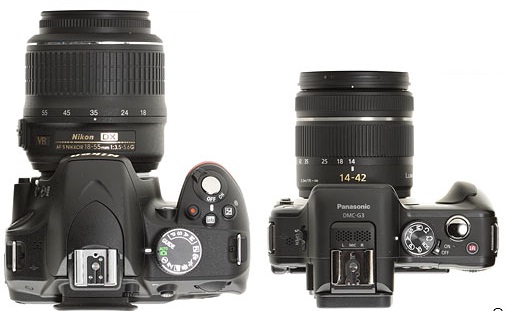
Side-by-side against the Panasonic G3, it's immediately apparent the size trade-off you make to retain an optical viewfinder. In this comparison the mirrorless Panasonic has a slightly smaller sensor, but Sony's NEX and Samsung's NX models aren't much larger than the G3 while boasting APS-C sensors.


The D3200 is very similar in size to Canon's Rebel T3/EOS 1100D, with which it nominally competes. The T3, while a very likeable camera, looks very off-the-pace with its 12MP sensor, 720P movies and 230k dot screen.


Wi-Fi option (WU-1a)

Alongside the D3200, Nikon announced an optional Wi-Fi transmitter for the camera. The WU-1a clips into the USB socket of the D3200 and allows you to broadcast its images to smartphones and tablets running a Nikon app. The unit allows the camera's live view output to be streamed to the smart device and allows images to be shot remotely (at a distance of up to 49ft, but with no control over the camera's settings).

Initially an app will be available for Android phones and tablets, with an iOS version expected in fall/autumn 2012. We're told the app will allow either full-size or VGA-resolution images to be transferred from the camera, but we have yet to see how long it would take to grab a 24MP image. We would also like to see how securely the unit attaches to the camera, given that it sticks out of the side, and looks like it might be a little easy to dislodge. It also requires the port cover that reaches all the way up the camera's flank to be left hanging open all of the time that it's in use.


Wednesday, June 6, 2012

First Impressions: Using the Nikon D800


As updates go, the Nikon D800 is a pretty major one. Compared to its predecessor the D700, Nikon's newest DSLR features an impressive set of key specifications, and subtly refined ergonomics, too. After more than three years we expected the D800 to outclass its predecessor, but products don't exist in a vacuum, and it wasn't long after the 12MP D700's announcement that Canon brought out the movie-shooting EOS 5D Mark II.

Not only was the 5D II Canon's first video-equipped DSLR, but at 21MP it offered a class-leading pixel count, effectively equal in resolution to Canon's professional EOS-1 Ds Mark III. The D700 won plaudits for its versatility, low light image quality and 51-point autofocus system, but it couldn't compete with the 5D II on resolution, or of course, video.

The D800 changes all that. Compared to the D700, the D800 is a thoroughly modern camera, boasting a highly advanced feature set for both still and video shooting. At 36.3MP the $3000 D800 comfortably eclipses its competitors in terms of pixel count and makes the $8000 Nikon D3X look distinctly irrelevant, too.

Compared to D700: Specification highlights
  • 36.3MP CMOS sensor (compared to 12.1MP)
  • 15.3MP DX-format capture mode (compared to 5MP)
  • 25MP 1.2x Crop mode
  • 51-point AF system with 15 cross-type sensors, rated to -2EV* (compared to -1EV)
  • ISO 100-6400 extendable to ISO 25,600 equiv (same as D700)
  • 1080p video at 30, 25 or 24 frames per second, up to 24Mbps, with uncompressed HDMI output and audio monitoring options*
  • 3.2", 921,000 dot LCD with anti-fog layer* (compared to 3in, 921k-dot)
  • Maximum 4fps continuous shooting in FX mode, 6fps in DX mode** (compared to 8fps in FX mode)
  • Advanced Scene Recognition System with 91,000 pixel metering sensor* (compared to 1005-pixel)
  • 'Expeed 3' Image Processing*
  • Dual-axis Virtual Horizon (on LCD screen/viewfinder)* (compared to single-axis)

* Same or almost identical to Nikon D4
** Maximum frame rate in DX mode is dependant on power source

We've had a D800 in the office for a few days, and we've spent that time shooting with the camera not only in our studio but also out in the big, bad 'real world'. We're some way off being able to publish a full review, but I wanted to share with you some first impressions. You've already read our in-depth preview, and you know what the professionals think, but now that we've got a production sample to play with, I want to give you an idea of what the D800 is actually like to use.

Handling

The D700 was a generally pleasant camera to hold and use, and so is the D800. Nikon hasn't made many drastic changes to the handling experience, and those that it has made are broadly in line with Nikon's design philosophy for 2011/12. Gone is the 'traditional' MF/AF-S/AF-C focus mode switch on the lens throat, to be replaced by the same combined MF/AF switch and AF mode button control that we've seen on the D7000 and D4. This updated approach to focus mode selection is nice and neat, because it associates all of the many options with a single physical control point, but as I pointed out in my recent article about the D4, it does make switching between AF-S and AF-C less rapid than it used to be.
 
Of more signficance to the average D7000 user will be the D800's updated drive mode dial and dedicated live view switch. Live view mode on the D700 was very much a 'first generation' implementation and although effective and useful, setting it via the drive mode dial was a pain, especially if you needed to grab a quick high or low-angle shot.

Improved Automatic ISO Sensitivity Mode

The D800's automatic ISO mode is inherited from the D4 and is improved over the same mode in earlier Nikon DSLRs. Previously, auto ISO customization was minimal, and consisted simply of an option to set the maximum ISO and minimum shutter speed when the camera was used in auto ISO mode. The currently-set ISO counted as the minimum ISO sensitivity (and in fact still does). This system was fine for shooting with a fixed focal length lens, but less useful with zoom lenses, where a 'safe' minimum shutter speed at either end of the focal range might be several stops apart.

In the D4 and D800, Nikon has (at long last) added an 'Auto' option to the minimum shutter speed options, which allows the camera to automatically set the minimum shutter speed based on its knowledge of the focal length that you're working at. This response can be biased in 5 steps, from 'slow' to 'fast' depending on whether you'd like the camera to err on the side of slower or faster shutter speeds. A small change but one that takes Auto ISO a little closer to being the 'set and forget' function that it should have been long ago.


Monday, June 4, 2012

Panasonic Lumix DMC-ZS20 Review


The Panasonic Lumix DMC-ZS20 is a compact travel zoom camera with a pretty elaborate GPS setup. Not only does the ZS20 log your location, it also has a database of a million landmarks and maps of ninety countries. The ZS20 also packs a new 20X zoom lens, 14.1 Megapixel MOS sensor (which Panasonic says has less noise than the CCD used in the ZS10), super-fast autofocus, 10 frame/second continuous shooting, a great auto mode, in-camera panorama stitching, and Full HD 1080/60p video recording. 

Compared to ZS10 and ZS15

As with all of Panasonic's recent travel zooms, the ZS20 has a little brother known as the DMC-ZS15. The ZS15 shares much in common with the ZS20, except for its lens (same as the ZS10), sensor (which is the same as the one on the DMC-FZ150 super zoom), and movie mode. It also lacks the touchscreen LCD and GPS functionality found on both the ZS10 and ZS20.


If you read last year's GPS-equipped Compact Ultra Zoom comparison, you may recall that I was quite disappointed with the DMC-ZS10, mostly due to its image quality. Panasonic says they've taken care of that on the ZS20. Did they? Find out now in our review!

Note that the DMC-ZS20 is known as the DMC-TZ30 in some countries. The DMC-ZS15 is also known as the DMC-TZ25. 

What's in the Box?

The DMC-ZS20 has a rather unremarkable bundle. Then again, so do most cameras these days. Inside the box, you'll find:
  • The 14.1 effective Megapixel Lumix DMC-ZS20 digital camera
  • DMW-BCG10 lithium-ion battery
  • AC-to-USB adapter
  • Wrist strap
  • USB cable
  • DVD featuring PhotoFunStudio 8.1 Premium Edition, Map Tool, and LoiLoScope trial
  • 34 page basic manual (printed) + full manual (on CD-ROM)
Despite being their flagship travel zoom camera, Panasonic has built just 18MB of memory into the DMC-ZS20. Needless to say, you'll want to buy a memory card right away, unless you have one sitting around already. The ZS20 supports SD, SDHC, and SDXC cards, and I'd recommend a 4GB card for most folks, and an 8GB or 16GB card for movie enthusiasts. You'll want a card rated Class 6 or faster for best performance, especially when it comes to movies.

The DMC-ZS20 uses the same DMW-BCG10 lithium-ion battery as its predecessor. This battery packs just 3.2 Wh of energy into its plastic shell, but thankfully Panasonic manages to squeeze pretty good battery life out of it, as you can see in this table. Note that battery life numbers are provided by the manufacturer, and are calculated with the GPS turned off.

The ZS20's battery life is a bit above the group average. That said, you might want to pick up a spare battery, as that GPS is power-hungry, especially if it's on all the time (more on that later). An extra battery will set you back around $32.

Panasonic has changed the way in which batteries are charged on their 2012 models. Batteries are now charged internally via the USB connector, which can be plugged into the wall or your PC. The reason why manufacturers are using this method more and more is pretty obvious to me: it costs a lot less to include a small AC-to-USB adapter than a full external charger. The bad news is that internal charging is a lot slower -- it takes a whopping 260 minutes to fully charge the ZS20's battery. Thankfully, Panasonic still sells the external charger (model DE-A65BA), which can be yours for about $25. It's more convenient than internal charging, allows you to charge a spare, and it's 100 minutes faster, too.

Something else about the included charger: while it's an AC adapter, you cannot use it to power the camera -- it's for charging only. If you want to use the ZS20 on "shore power", then you'll need to buy the hard-to-find AC adapter listed below.

Optional Accessories

   
A pretty short list, yes, but then again, the ZS20 is a compact camera. As I've hinted at several times, Panasonic accessories can be very hard to find - I don't even have prices for half of the stuff!

Panasonic includes PhotoFunStudio 8.1 Professional Edition software with the Lumix DMC-ZS20. This Windows-only software handles basic tasks fairly well, though the whole "wizard" system gets tired quickly. On the main screen you'll see the usual thumbnail view, and you can view photos by folders, date, or by things as specific as scene mode. The software can learn to recognize faces (much like the camera itself), which offers you another way to browse through your pictures. Available editing features give you the ability to crop, rotate, or change the aspect ratio of your photos, as well as adjusting color, brightness, saturation, and more. You can apply special effects to photos, overlay text, or remove redeye. Something else that's nice is that the software maintains a history of the changes you've made to a photo, so you can go back in time if you don't like something you've done.

Another included program is Lumix Map Tool (for Mac and Windows), which lets you choose which maps of the world you want to load onto your memory card. The North/Central America map is 1.88 GB, so maybe getting that 8 GB SDHC card isn't such a bad idea, after all. Another important application, known as GPSASIST, is actually built into the camera itself. When you attach it to your Mac or PC via USB, select "GPS Assist Data" on the camera, and you'll find the software on the virtual disk mounted by the camera. Loading the GPS Assist Data can reduce satellite acquisition times.

As with other recent Panasonic cameras, the ZS20's manuals are split into two parts. In the box is a leaflet that will get you up and running, but not much further. For more information about the camera, you'll have to load up the full manual, which is in PDF format on the DVD that comes with the camera. The full manual certainly won't win any awards for user-friendliness, but it should answer most questions you'll have about the ZS20. Instructions for using the included software is installed onto your PC.

This review was first published at www.dcresource.com, and is presented here with minimal changes, notably the inclusion of a full set of product images, our usual studio comparisons and an expanded samples gallery, plus the addition of a standard dpreview score.